
Is Traditional SEO Enough in the Age of AI Search?
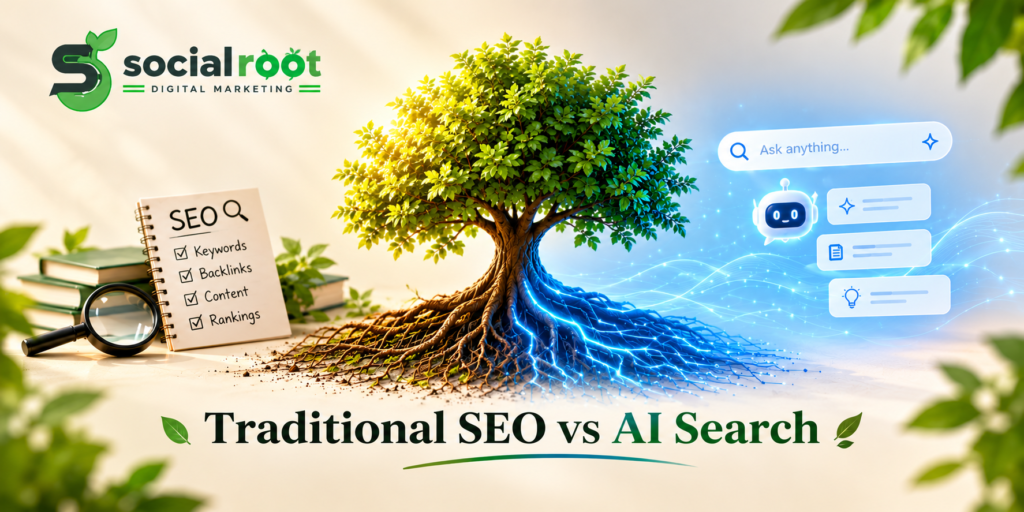
The digital world is changing rapidly, and the way people search for information is evolving with it. Traditional search engines like Google remain important, but users are increasingly discovering information through AI-powered tools such as ChatGPT, Google AI Overviews, and Gemini.
This shift raises an important question for businesses: Is traditional SEO enough in the age of AI search?
The answer is no—not on its own. Traditional SEO remains the foundation of online visibility, but businesses must also adapt their content and digital marketing strategies to improve their chances of being discovered through AI-powered search experiences.
In this blog, we will explore how SEO is changing, why AI search matters, and what businesses can do to stay visible online.
What Is Traditional SEO ?
Traditional Search Engine Optimization (SEO) is the process of improving a website so that it appears more prominently in search engine results pages. Its primary goal is to attract relevant organic traffic without relying entirely on paid advertising.
Traditional SEO focuses on several important areas:
Keyword research: Identifying the words and phrases people use when searching online.
On-page SEO: Optimizing page titles, headings, content, meta descriptions, and internal links.
Technical SEO: Improving website speed, mobile usability, crawlability, indexing, and site structure.
Off-page SEO: Building credibility through relevant backlinks and brand mentions.
Content optimization: Publishing helpful, relevant, and informative content that answers users’ questions.
These practices remain valuable because search engines still need to discover, understand, and evaluate web content.
What Is AI Search ?
AI search uses artificial intelligence to understand questions, summarize information, and generate responses based on relevant sources. Instead of presenting only a list of links, AI-powered search experiences may provide direct answers, summaries, recommendations, and links to supporting websites.
Examples include Google’s AI Overviews, Google’s AI Mode, ChatGPT search, and Gemini.
For example, a user searching for “Which digital marketing strategy is best for a small business?” may receive an AI-generated explanation comparing SEO, social media marketing, and paid advertising.
This creates a new opportunity for businesses to make their expertise discoverable—not only through traditional search rankings but also through relevant AI-generated answers.
However, appearing in an AI response is not guaranteed, even if a website ranks well in traditional search results.
Why Traditional SEO Along May Not Be Enough ...
Traditional SEO continues to play a major role in online visibility, but changing search experiences mean businesses should consider a broader approach.
1.Content Quality Is More Important Than Keyword Repetition
Repeating a keyword excessively does not make content valuable. Search engines and AI-powered experiences are designed to help users find useful information, not simply pages containing the highest number of repeated phrases.
What businesses should do: Focus on search intent, factual accuracy, clear explanations, and practical advice. Use keywords naturally rather than writing content solely to satisfy a keyword count.
2.Search Result Are Becoming More Converational
People increasingly ask detailed questions instead of searching only for short keywords. AI-powered tools can interpret the context behind these questions and generate more conversational responses.
What businesses should do: Create content that answers specific customer questions clearly. Use descriptive headings, explain concepts in simple language, and cover related questions that customers are likely to ask.
3.AI Search can Provide Answer Without A website Visit
Traditional search often encourages users to click through a list of results. AI-generated summaries may answer some questions directly, meaning users do not always need to visit a website.
This can change organic traffic patterns, depending on the search topic and the search experience.
What businesses should do: Offer useful information while also giving readers a reason to visit your website. Provide original insights, detailed guides, case studies, useful resources, and clear next steps.
4.Brand Authority Matters
AI search systems may use multiple sources to develop answers. Consistent, credible information about a business can help people and search systems understand its expertise.
What businesses should do: Publish accurate information, demonstrate relevant experience, maintain consistent business details, earn legitimate industry mentions, and collect genuine customer reviews where appropriate.
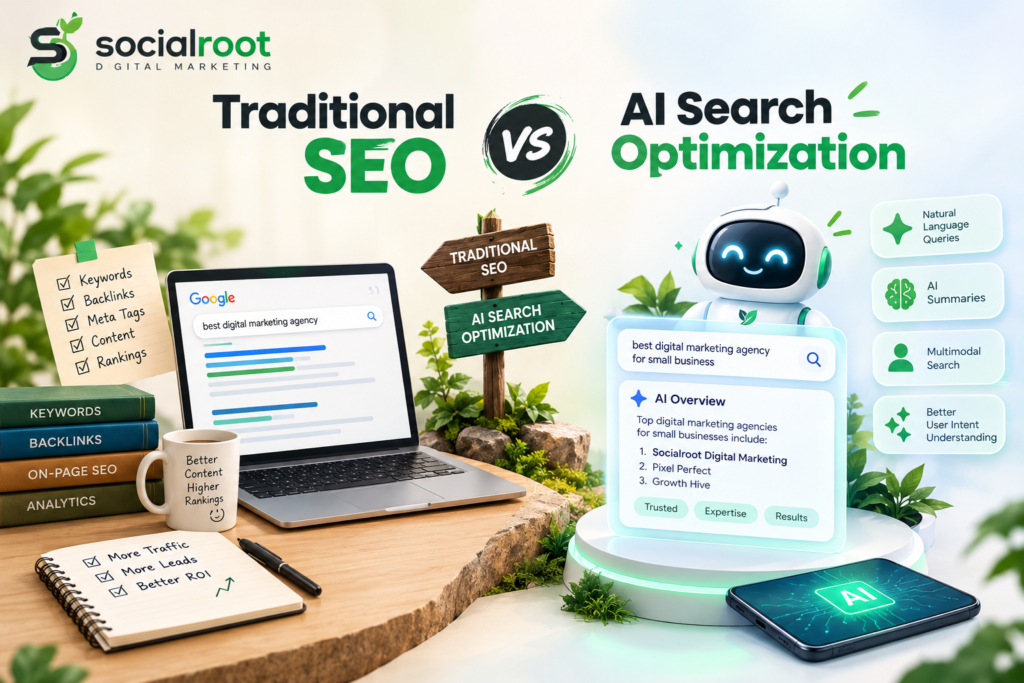
Traditional SEO vs AI Search Optimization
Traditional SEO
| Focuses on visibility in search engine results |
Targets keywords and search intent |
| Uses technical SEO, content, and backlinks |
| Often measures rankings, impressions, and organic clicks |
| Aims to attract relevant visitors from search |
AI Search Optimization
| Focuses on discoverability in AI-generated answers as well |
| Emphasizes questions, context, and clear answers |
| Builds on SEO with additional emphasis on clarity and credible information |
| May also consider AI referrals, citations, and brand mentions where measurable |
| Aims to help users discover and understand a brand across AI search experiences |
What Does The Future Of SEO Look Like ?
SEO is not disappearing; it is evolving alongside the way people discover information.
Traditional search engines remain important, while AI-powered search experiences introduce additional ways for users to find answers and evaluate businesses. The strongest strategy is to build a technically sound website, publish genuinely useful content, establish credibility, and make your brand information easy to understand across relevant platforms.
Businesses that focus only on rankings may miss other opportunities for discovery. Businesses that focus only on AI trends may overlook the fundamentals that make their websites valuable in the first place.
The goal is not to choose between SEO and AI search. It is to build a strategy that supports both.
Conclusion
Traditional SEO remains essential, but businesses must also adapt to AI-powered search. By creating helpful content, building brand credibility, and optimizing their online presence, businesses can improve their opportunities for visibility. At Socialroot, we help brands grow through smart digital marketing strategies that connect them with the right audience.